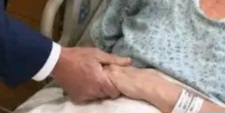
The fluorescent lights above my hospital bed hummed with that cold, mechanical sound that makes you feel more alone than you already are. I blinked slowly, my throat dry as sandpaper, trying to focus on the clock mounted on the sterile white wall. Three twenty-seven in the afternoon. The anesthesia was still making everything feel fuzzy around the edges, but one thing was crystal clear. The silence.My name is Adrienne Davis, and I’m sixty-four years old. Three hours earlier, I had undergone what my cardiologist called a routine procedure to clear a blocked artery. Nothing too serious, he’d assured me, though at my age any surgery involving the heart carries its own kind of risk. I’d asked my three children to be here when I woke up. David, my oldest at thirty-eight, had promised he’d take the day off from his accounting firm. Sarah, thirty-five and between jobs again, said she’d bring flowers. Michael, my baby at thirty-two, had rolled his eyes but agreed to come by after his sales calls.The room smelled like industrial disinfectant and something else I couldn’t quite place. Fear, maybe. Or disappointment. The machines beside my bed beeped steadily, monitoring my heart rate, my blood pressure, my oxygen levels, everything the doctors needed to know about how my body was functioning. But no machine could measure the hollow ache spreading through my chest that had nothing to do with the surgery itself.I turned my head toward the window, wincing at the sharp pull of the IV line in my neck. Outside, the Seattle sky hung its usual gray, threatening rain that might or might not eventually fall. Cars moved through the parking lot below, people going about their lives, visiting their own loved ones. Where were mine?“Mrs. Davis?” A voice broke through my fog of confusion and growing panic. I turned to see a young nurse with kind eyes and strawberry blonde hair pulled back into a ponytail, her scrubs covered in cheerful cartoon cats that seemed absurdly optimistic against the sterile backdrop of the room. “Yes,” I whispered, my voice barely audible, my throat still raw from the breathing tube.She approached my bed with a gentle smile that didn’t quite reach her eyes. “How are you feeling? Any pain? Nausea?” I shook my head slightly. “Where are my children? Did they leave a message?” Her smile faltered. She glanced down at her tablet, then back at me, clearly uncomfortable. “Well, they were here earlier, during your surgery, in the waiting room. And now…” She hesitated, and in that pause my heart rate monitor began beeping faster.“Just tell me,” I said, my voice growing stronger, though my hands had started to shake. “They left about an hour ago,” she said finally. “The gentleman at the front said they mentioned the parking fees were getting too expensive, and that they’d check on you later.” The words hit me like a physical blow. Parking fees too expensive. I stared at her, certain I’d misheard. “I’m sorry. What did you say?” Her cheeks flushed pink. “I’m so sorry, Mrs. Davis. I probably shouldn’t have told you that directly. I’m sure they’ll be back soon. People sometimes need to step out, get some air, grab something to eat—” Her voice trailed off, because we both knew she was inventing excuses for something inexcusable.My children, the three people I had raised and loved and sacrificed for across three decades, had left me alone after heart surgery because they didn’t want to pay for parking. The tears came suddenly, without warning. Not the gentle, dignified tears of a woman my age, but raw, choking sobs from somewhere far deeper than my chest incision. The nurse reached for the tissue box on my bedside table. “Mrs. Davis, please, don’t upset yourself, your heart needs rest right now. Can I call someone else for you? A friend, another family member?”I couldn’t speak. Couldn’t stop crying. Couldn’t process the fact that I was sixty-four years old, lying in a hospital bed after heart surgery, and my own children had abandoned me over a fee that couldn’t have been more than twenty or thirty dollars for the entire day.Through my tears, I heard footsteps in the hallway. Heavy, confident footsteps that paused right at my doorway. The nurse looked up, her expression shifting instantly to professional attention. “Excuse me,” a deep, gentle voice said. “Is this Mrs. Adrienne Davis?”I wiped my eyes with the back of my hand, trying to compose myself enough to see who was speaking. A tall man in an expensive dark suit stood in the doorway, probably in his mid-fifties, with salt-and-pepper hair and kind brown eyes behind wire-rimmed glasses. Everything about him suggested success and quiet authority, from his perfectly tailored jacket down to the leather briefcase in his hand.The nurse straightened. “Yes, but visiting hours—” “It’s all right,” he said quietly, stepping into the room, his presence somehow filling the space without overwhelming it. “Mrs. Davis, my name is Malcolm Chen. You won’t remember me, but…” He paused, his voice catching. “You paid for my lunch every day in third grade.”I stared at him, confusion cutting straight through my emotional turmoil. Third grade. That would have been decades ago, when I was sixteen, working as a teacher’s aide at Franklin Elementary to help earn extra money for my family. But I couldn’t place him. Couldn’t remember. He seemed to understand my confusion and stepped closer, hands clasped respectfully in front of him. “Mrs. Davis, you probably helped so many children over the years that you don’t remember all of them. But I remember you. You saved my life.”The nurse glanced between us uncertainly. “Sir, if you’re not immediate family—” “Actually,” Malcolm said, his tone shifting, taking on a more authoritative note while somehow staying gentle, “I own this hospital.” My tears stopped abruptly. I blinked hard, certain the anesthesia was playing tricks on me. “You what?” The nurse’s eyes widened, and she excused herself quickly, mumbling something about checking on other patients. Malcolm watched her go, then turned back to me with a small, sad smile. “May I sit down?” he asked, gesturing to the chair beside my bed.I nodded, unable to find my voice. He sat carefully, setting his briefcase on the floor, and for a moment simply looked at me with eyes that seemed familiar now, though I still couldn’t place them in the face of a child from so long ago. “I’ve been looking for you for years,” he said quietly. “Ever since I finished medical school and started building my career, I always wondered what happened to the teacher’s aide who made sure a hungry little boy didn’t go without lunch.”My heart monitor beeped faster again, but this time not from distress. From a strange mixture of confusion, hope, and something I couldn’t quite name. “I don’t understand,” I whispered. “Malcolm Chen, I’m sorry, I truly can’t remember.” “You wouldn’t,” he said gently. “I was just one of many kids you helped. Back then, my name was Malcolm Peterson. I was adopted by the Chen family when I was twelve.” He paused, hands clasped tightly in his lap. “Mrs. Davis, do you remember a boy who never had lunch money? Whose clothes never quite fit right? Who sat alone in the cafeteria, watching other kids eat?”Slowly, like fog lifting from an old photograph, an image began to form. A small boy with dark hair that never seemed properly cut, large brown eyes, a face too thin, clothes always a little too big, a little too worn, and lunchtimes where he sat alone, pretending he wasn’t hungry. “Oh my God,” I breathed. “Malcolm. Little Malcolm. You were so quiet, so—” “Hungry,” he finished gently. “Every day. My biological parents—well, that’s not important now. What matters is that you noticed. You saw a kid falling through the cracks, and you did something about it.”The memory sharpened further. I had been working at Franklin Elementary to supplement my family’s income, already helping my own parents pay bills at sixteen, already learning what it meant to sacrifice for the people you loved. I had noticed Malcolm because he reminded me of myself, trying so hard to be invisible, trying not to be a burden to anyone.“You never asked questions,” he continued, his voice thick with emotion. “You never made me feel like charity. You just found a way to make sure I had lunch every single day, for two whole years.” I remembered now, the way I used to slip him extra lunch tickets, telling him the cafeteria had made too much food and needed someone to help finish the leftovers, and the way his whole face would light up whenever I handed him a tray, as if I’d given him the entire world.“Malcolm,” I said, fresh tears starting to fall, “you were just a baby. You were so thin.” He reached out and gently took my hand, and the warmth of that human contact after hours of cold abandonment nearly undid me all over again. “Mrs. Davis,” he said softly. “When I woke up this morning, I had no idea this would be the day I’d finally get to thank you. When my assistant told me there was an Adrienne Davis having surgery here, I had to come see if it was really you.”I squeezed his hand. This successful man, who had once been a hungry little boy I’d tried to protect. “I can’t believe it. Look at you. You became a doctor. You own a hospital.” “Because of you,” he said simply. “Because someone showed me that kindness existed in the world. That I was worth caring about.”We sat in silence for a moment, his hand warm in mine, the steady beeping of the machines marking time. Outside, the Seattle sky grew darker, but somehow the room felt brighter than it had all day. “Mrs. Davis,” Malcolm said carefully, “I noticed you were alone when I came in. Is there no one here with you?”And just like that, the pain came flooding back, made even more stark by this unexpected kindness from a stranger who wasn’t really a stranger at all. “My children,” I said, my voice breaking. “They left. They said the parking was too expensive.” Malcolm’s grip on my hand tightened, and something flashed across his face, anger perhaps, or disbelief. When he finally spoke, his voice was carefully controlled. “I see,” he said quietly. “Well, then it’s a good thing I’m here, because Mrs. Davis, I made a promise to myself a long time ago. If I ever found the woman who saved that hungry little boy, I was going to make sure she was never alone when she needed someone.”Malcolm stayed with me until the evening shift change. For the first time since waking up, I didn’t feel abandoned. He insisted on having the kitchen send up real dinner for both of us, not the standard hospital fare, and we ate slowly while he told me about his journey from that hungry third grader to the man sitting beside my hospital bed.“After the Chens adopted me,” he said, cutting his salmon into precise pieces, “everything changed. They gave me stability, education, love. But I never forgot those two years at Franklin Elementary. I never forgot being hungry. And I never forgot the teacher’s aide who made sure I wasn’t.”I picked up my own meal, still overwhelmed by the day’s events. “I just did what anyone would do.” “No,” Malcolm said firmly, setting down his fork. “That’s not true, and we both know it. Mrs. Davis, may I call you Adrienne?” I nodded, suddenly feeling shy in front of this accomplished man who was treating me with more care than my own children had shown all afternoon.“Adrienne, do you remember how you paid for those lunches?” I frowned, thinking back. “I had my teacher’s aide salary. It wasn’t much, but—” “Three dollars a day,” he said quietly. “That’s what school lunch cost back in 1975. You were making about two hundred dollars a month as an aide. Do you know what three dollars a day meant against that salary?” I shook my head, though something uncomfortable was already stirring in my memory.“It meant you were spending almost half your paycheck feeding me. A kid you barely knew. A kid whose own parents couldn’t be bothered to provide for him.” The memory hit me like a physical blow. I had forgotten, or maybe forced myself to forget, how tight money had been back then. I was sixteen, trying to help my own family cover rent, and yes, I had been spending nearly half my earnings feeding a boy who reminded me too much of myself. I had eaten peanut butter sandwiches for two years so Malcolm could have hot meals.“I remember now,” I whispered. “I remember being hungry too. But you were so little, and you looked so lost.” “I was lost, Adrienne. And you found me.” He reached into his briefcase and pulled out something that made my heart skip. A yellowed lunch card from Franklin Elementary, the kind they used to punch holes in when you bought a meal, this one worn soft from decades of handling, the edges frayed nearly to threads. “I kept this,” he said, holding it carefully. “All these years. It’s the last card you ever gave me, before the school year ended, before I never saw you again.”I took the card with trembling fingers, remembering the texture of it, the faint smell of the cafeteria’s industrial food that seemed to still cling to the memory. “Why did you keep this?” “Because it represented hope,” he said simply. “When the world seemed dark and I felt like nobody cared whether I lived or died, I’d look at that card and remember that someone had noticed me. Someone had thought I was worth feeding.”Tears threatened again, though these felt different, cleaner somehow. “Malcolm, I had no idea. I just saw a hungry child, and—” “And you acted without hesitation, without expecting anything in return.” He leaned forward slightly. “Do you know what I did with that lesson?” I shook my head. “I became a doctor because I wanted to help people the way you helped me. I specialized in pediatrics first, then moved into hospital administration so I could help on a larger scale. And every business decision I’ve made since, every policy I’ve implemented across my hospitals, has been guided by one single question. What would Adrienne do?”The weight of his words settled over me. This successful man, this owner of multiple hospitals, had been carrying my influence with him for decades. While I had been struggling to raise my own children, working multiple jobs, barely keeping my head above water, my simple act of kindness had been quietly growing into something I never could have imagined.“I built my first clinic in a low-income neighborhood,” Malcolm continued. “A free lunch program for kids whose families couldn’t afford it. Then I expanded into full medical services. Now I own four hospitals across the Pacific Northwest, and every single one of them has a program to make sure no child goes hungry while receiving treatment.”I stared at him, overwhelmed. “Because of school lunches?” “Because of you,” he corrected gently. “Because you taught a little boy that kindness exists, even when the world feels cruel.” We sat in comfortable silence for a while, the hospital’s evening sounds settling around us, a baby crying somewhere down the hall, elevator bells chiming softly, the ordinary sounds of life continuing, of people being cared for.“Malcolm,” I said finally. “Can I ask you something?” “Anything.” “How did you find me? Today, I mean. After all these years, how did you know I was here?” His expression grew more serious. “I’ve had a standing request with several private investigation firms for the past fifteen years. Anytime an Adrienne Davis of the right age appeared in public records anywhere in the Pacific Northwest, they’d notify me. When you registered for surgery here, it triggered an alert.”
My Children Left Me Alone After Heart Surgery Over Parking Fees Then the Hospital Owner Walked Into My Room